Oleshky in Global Media: An Analysis of Coverage and Narratives in 2026

From social media to news outlets in 46 countries: How the world covered the humanitarian crisis in Russian-occupied Oleshky, which stories gained the most attention, and how Russia sought to shift the blame onto Ukraine.
In September 2026, reports of hunger in Oleshky, a Russian-occupied town in southern Ukraine, began reaching audiences far beyond the country’s borders. Reuters, The Guardian, Al Jazeera, and European public broadcasters covered the plight of residents facing severe food and medicine shortages, as well as dangerous and limited evacuation routes.
The first notable increase Minos recorded came on September 11–12, when discussion gained momentum on social media. Major international news outlets would take up the story later that month.
By September 27, the number of international posts and articles about Oleshky had reached 252 in a single day. The focus was also changing. Alongside accounts of hunger and the blockade, stories about food deliveries by drone, attempts to evacuate civilians, and animal rescues were attracting growing attention. Meanwhile, Russian state media and pro-war Telegram channels were promoting a competing account that blamed Ukraine for the humanitarian crisis.
To understand how international attention developed and which narratives shaped the conversation, we examined data collected through Minos Brand Watch, an information monitoring tool developed by Molfar Intelligence.
Between August 25 and October 6, 2026, Minos recorded 2,395 international posts and articles from 1,435 sources, including news coverage from 46 countries. A separate dataset covered 162 publications from 42 Russian sources.
The findings reveal how major developments coincided with spikes in coverage, how the stories receiving attention changed over time, and how Russian sources attempted to shape the narrative surrounding the crisis.
Key Takeaways
- 2,395 international posts and articles from 1,435 sources were recorded by Minos, including news coverage from outlets in 46 countries.
- September 27 marked the peak of international attention, with 252 posts and articles recorded that day.
- 72% of the international content came from individual social media users. The first notable surge appeared on September 11–12, before the main wave of international news coverage.
- 74% of the international publications addressed hunger and the humanitarian crisis, making this the most prevalent theme.
- The share of content about drone-delivered food aid rose from 6% to 28% over three weeks.
- 162 publications from 42 Russian sources formed a separate dataset. Their dominant counter-narrative sought to shift responsibility for the crisis onto Ukraine.
Overview of the Data
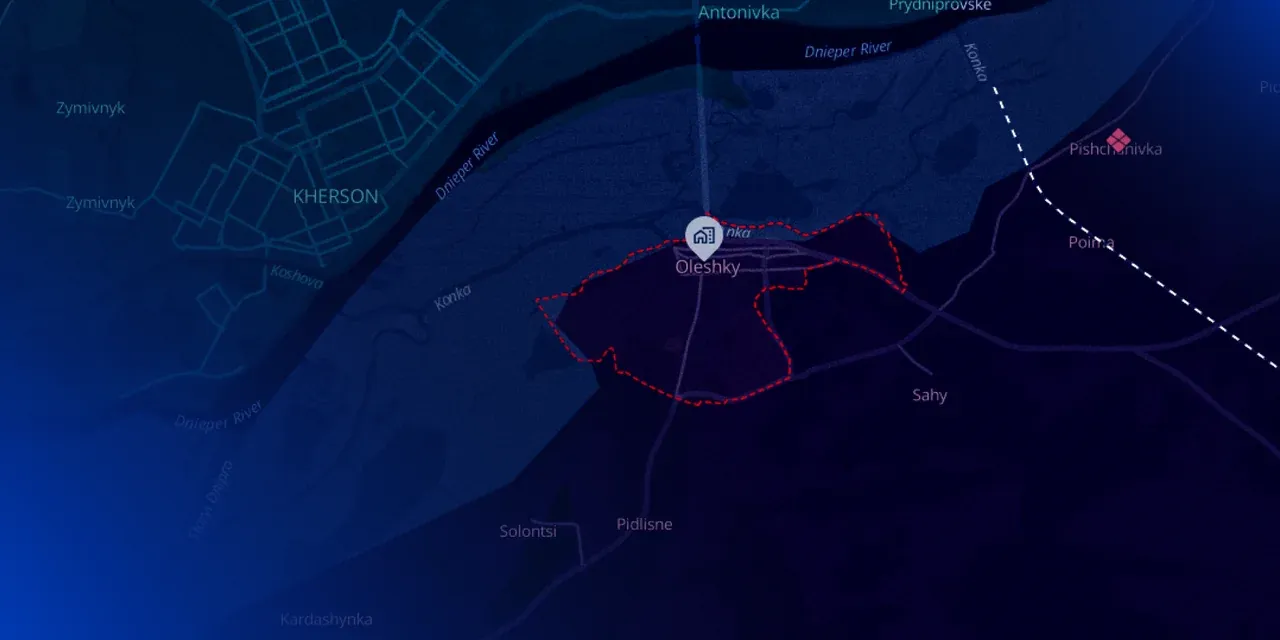
Oleshky lies on the eastern, or left, bank of the Dnipro River, across from the Ukrainian city of Kherson. The town has been under Russian occupation since 2022. Its proximity to the front line, mined areas, and the constant threat of attacks have severely restricted civilians’ access to food, medicine, and safe evacuation routes.
The situation drew greater international attention in September. On September 23, Ukrainian Foreign Minister Andrii Sybiha raised the humanitarian crisis in Oleshky during a United Nations Security Council meeting held in New York as part of the UN General Assembly’s high-level week. Russian officials acknowledged serious supply problems but blamed Ukraine for them.
Against this backdrop, international and Russian sources showed different patterns of activity. Minos recorded 2,395 publications in its international dataset and 162 in a separate Russian dataset. These figures describe the material captured by the monitoring process, not the total volume of coverage across either information environment.
| Metric | International sources | Russian sources |
|---|---|---|
| Posts and articles | 2,395 | 162 |
| Sources | 1,435 | 42 |
| Potential social media audience | 199 million | 24 million |
| Negative sentiment | 59% | 75% |
| Neutral sentiment | 24% | 16% |
| Positive sentiment | 17% | 9% |
Source: Minos Brand Watch, August 25–October 6, 2026. Potential audience represents the combined follower counts of the sources, not actual views or unique readers. Sentiment was classified automatically.
The platforms used to share information also differed considerably.
Social media dominated the international dataset. Facebook accounted for 52% of recorded content, followed by Threads at 33% and X at 9%. News websites represented approximately 5%.
In the Russian dataset, Telegram was the leading platform, accounting for 55% of publications. News outlets made up another 36%, while other social media platforms accounted for 9%.
Although negative sentiment prevailed in both datasets, the content behind it differed sharply. International coverage largely focused on hunger, the blockade, and the conditions facing civilians. Russian sources, by contrast, concentrated on accusations against Ukraine.
How International Attention Developed
International attention to Oleshky did not emerge all at once. Minos recorded the first notable increase in social media activity on September 11–12. Major international news outlets subsequently took up the story, and coverage reached its highest level toward the end of the month.
Different developments accompanied each new surge.
September 11–12: The First Surge on Social Media
Social media users shared reports about the humanitarian crisis, called on international organizations to respond, and promoted the #SaveOleshky campaign.
Minos recorded the first significant rise in international activity during these two days, before coverage by major news organizations gained momentum.
September 18–27: The Story Reaches Major News Outlets
Coverage intensified alongside diplomatic statements and new reporting on conditions in the town.
On September 23, Foreign Minister Andrii Sybiha raised the humanitarian crisis at the UN Security Council. He called on the international community to press Russia to open humanitarian corridors and allow aid to reach civilians. A banner displayed at a soccer match in Budapest also drew attention to the plight of Oleshky residents.
On September 27, The Guardian published a report detailing the dire living conditions in the occupied town. That same day, Ukrainian authorities announced that food and medical supplies had been delivered to Oleshky using drones. Reuters covered the operation the following day.
The timing suggests that diplomatic appeals, public solidarity campaigns, and reporting by major outlets may have reinforced one another, helping bring the crisis to a wider audience.
September 27 marked the highest level of international activity in the entire monitoring period, with 252 posts and articles recorded in a single day.
October 3–5: Rescue Stories Bring Renewed Attention
International discussion picked up again in early October.
This time, prominent stories included residents attempting to escape through mined areas, further drone deliveries of food, and efforts to rescue animals trapped in the occupied town.
The September peak was therefore not the end of international interest. As new accounts of aid deliveries and rescue operations emerged, they gave news outlets and social media users fresh reasons to return to the story.
Russian sources followed a different timeline. Their first notable spike came on September 2, followed by increases on September 29 and October 1, after the main international peak. These surges accompanied accusations against Ukraine, examined in greater detail in the section on Russia’s counter-narrative.
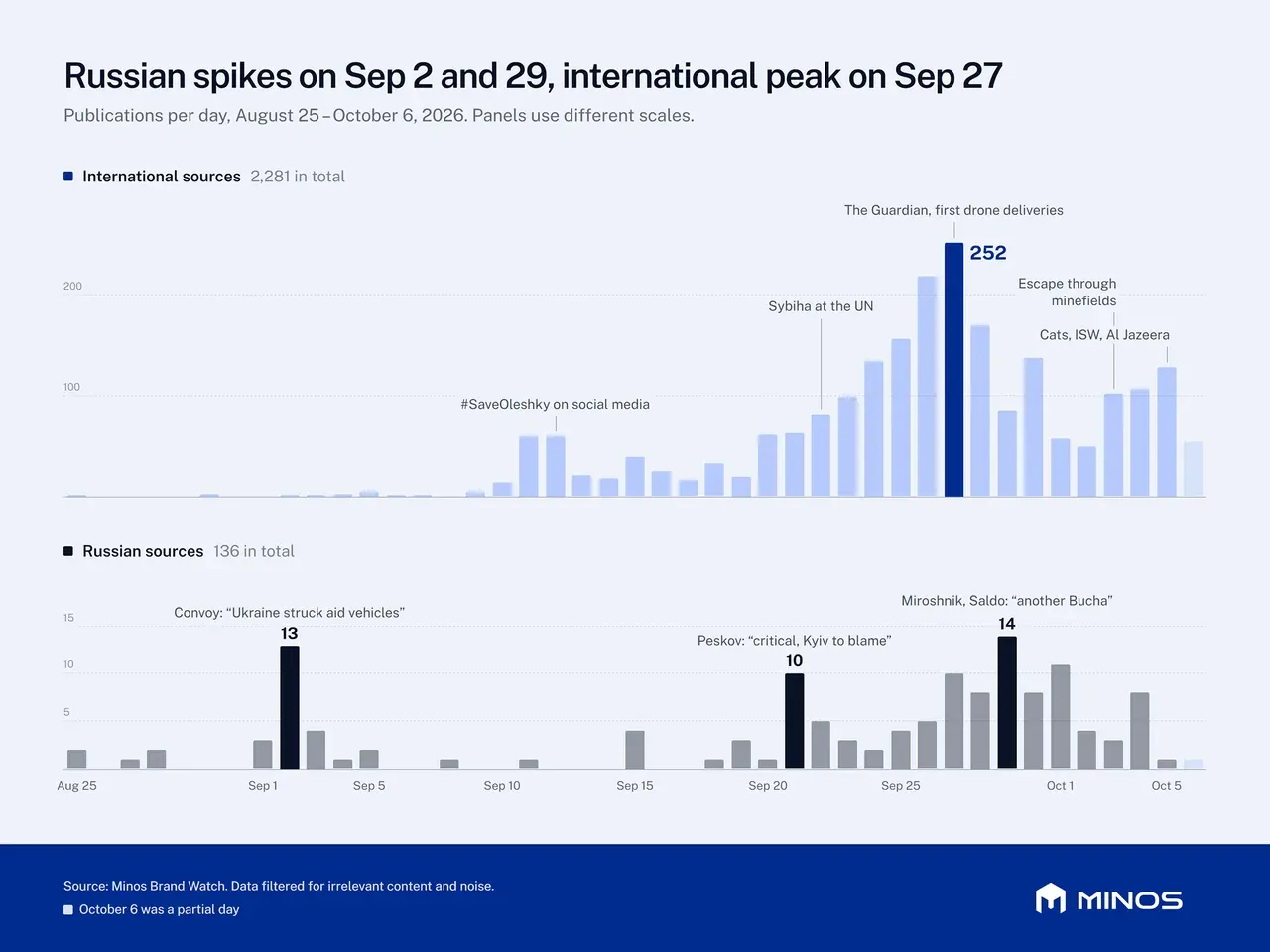
Chart note: Minos initially recorded 2,395 international publications and 162 Russian publications. After irrelevant content and noise were filtered out, 2,281 international and 136 Russian publications remained in the datasets used to analyze daily activity. The chart reflects these filtered figures. October 6 was a partial day and should not be directly compared with previous full days.
Where the Story Received International News Coverage
News outlets in 46 countries reported on the humanitarian crisis in Oleshky, from Ukraine’s neighbors to Japan, Mexico, and Argentina.
But attention was far from evenly distributed. Central and Eastern Europe accounted for the largest concentration of coverage.
In a selection of 104 key news articles examined by Minos, 36 appeared in Central and Eastern European outlets, representing approximately 35% of the sample. Poland, the Czech Republic, and Romania were among the most active countries, with five to seven outlets covering the story in each. Media in Greece and Bulgaria also paid notable attention to the crisis.
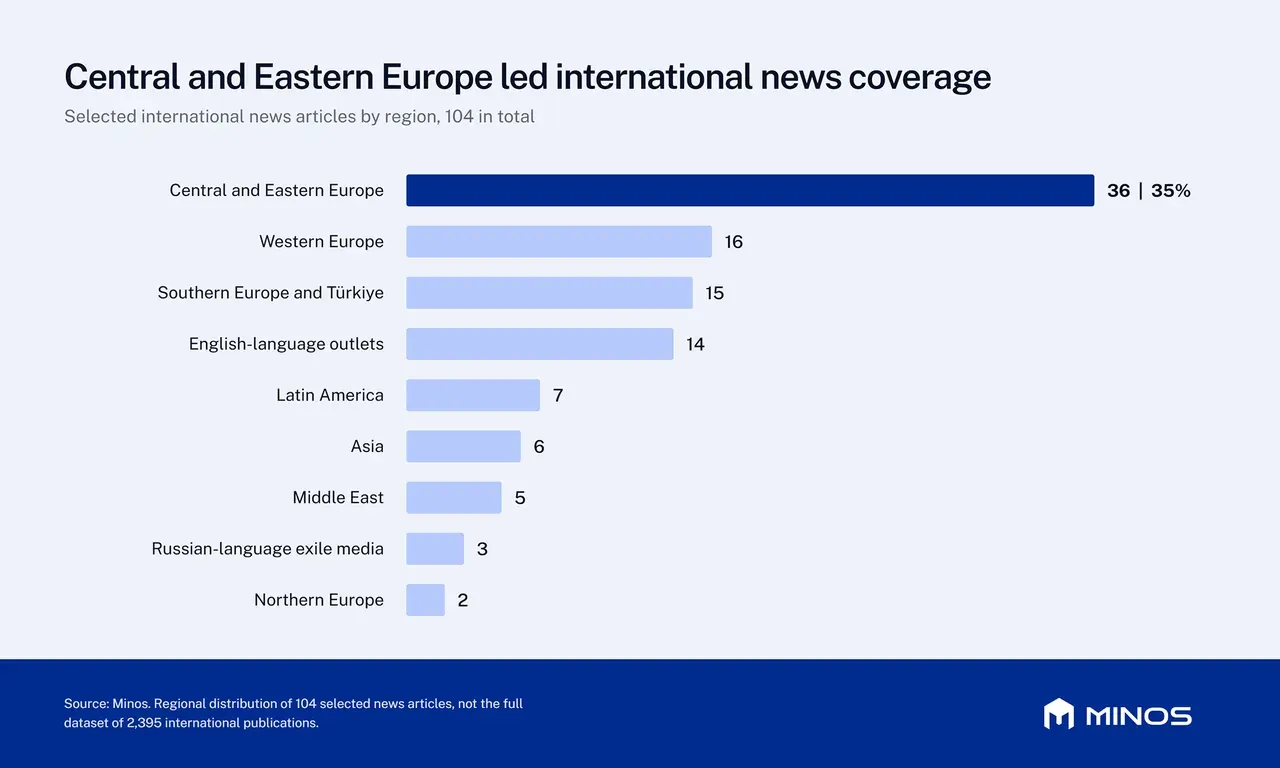
Source: Minos. The chart shows the regional distribution of 104 selected news articles. This is not the full dataset of 2,395 international publications, which also included social media.
Coverage by public broadcasters was particularly notable. The story appeared on platforms operated by Austria’s ORF, Belgium’s VRT, the Czech Republic’s ČT24 and iROZHLAS, Poland’s TVP, Lithuania’s LRT, Sweden’s SVT, and Ireland’s RTÉ.
This meant the crisis was reaching national audiences beyond activist communities and outlets specializing in the war in Ukraine.
The focus of coverage also varied by region.
In Central and Southern Europe, coverage more frequently emphasized emotionally powerful accounts of hunger and harsh living conditions. English-language outlets generally took a more restrained approach, relying heavily on witness testimony and official sources.
Meanwhile, reports in media from Arab countries, China, and Latin America gave particular attention to drone deliveries of food. These stories presented the humanitarian crisis through an unusual method of reaching civilians in an active conflict zone.
Broad geographic reach did not, however, translate into equally extensive reporting by every major international newsroom. The monitored dataset did not identify standalone articles from The New York Times, CNN, the Associated Press, or Der Spiegel during the period studied. This does not rule out mentions or coverage outside the monitored sample.
The regional differences are revealing. In some countries, Oleshky was primarily a story about hunger and civilian suffering. Elsewhere, efforts to deliver aid using drones became a prominent part of the coverage. Understanding international attention requires looking not only at where a story appeared, but also at which aspects resonated with different audiences.
Main Themes and Narratives
Reports of hunger and the humanitarian crisis dominated international discussion of Oleshky, appearing in 74% of the publications analyzed.
Almost half (46%) addressed the blockade, humanitarian access, or evacuation efforts. Beyond these immediate concerns, coverage revolved around three broader questions: What was happening to residents? What was being done to help them? And who was responsible?
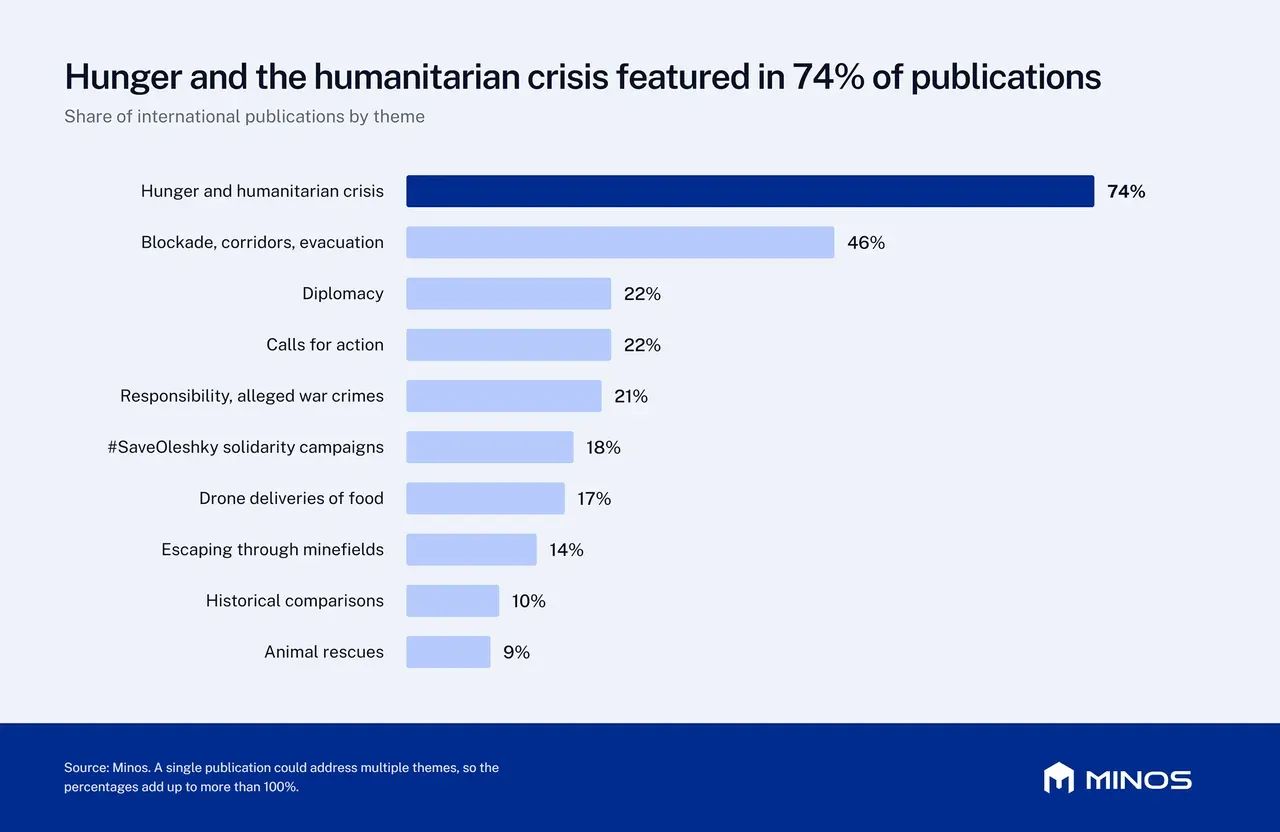
| Theme | Share of publications |
|---|---|
| Hunger and humanitarian crisis | 74% |
| Blockade, humanitarian corridors, and evacuation | 46% |
| Diplomacy | 22% |
| Calls for action | 22% |
| Responsibility and alleged war crimes | 21% |
| #SaveOleshky solidarity campaigns | 18% |
| Drone deliveries of food | 17% |
| Escaping through minefields | 14% |
| Historical comparisons | 10% |
| Animal rescues | 9% |
Source: Minos. A single publication could address multiple themes, so the percentages add up to more than 100%.
Historical comparisons offered another way for journalists and commentators to convey the gravity of the situation.
Some coverage drew parallels with the Holodomor, the devastating famine in Soviet Ukraine in 1932–33, as well as historical sieges and other humanitarian tragedies. Greek media, for example, referenced the siege of Missolonghi, a landmark episode in Greece’s struggle for independence.
Such references connected the crisis to historical experiences familiar to local audiences. They reflect how the events were framed in public discussion, rather than any legal determination of what took place in Oleshky.
From Reports of Hunger to Stories of Humanitarian Aid
One of the most striking shifts in international coverage was the growing attention to humanitarian operations.
Early reporting focused heavily on food shortages, the town’s isolation, and the lack of safe evacuation routes. Toward the end of September, more publications began covering attempts to deliver supplies to residents.
On September 27, Oleksandr Prokudin, head of the Kherson Regional Military Administration, reported that approximately four metric tons of food and medical supplies had been delivered by heavy-lift drones to 100 locations across the occupied town.
Reuters covered the operation the next day, and the story subsequently appeared in media across other regions.
Over three weeks, the share of publications discussing drone deliveries of food rose from 6% to 28%.
The shift was significant not only in scale. Drone deliveries had become a story in their own right, combining urgent humanitarian needs with an unconventional use of technology.
The subject attracted particular attention in media from Arab countries, China, and Latin America. It offered an additional angle on the crisis: not just the conditions people were enduring, but also an unusual way of reaching civilians in a war zone.
Other rescue stories emerged in early October. One social media story that attracted attention described the evacuation of a cat and her five kittens using a drone.
The changing focus of coverage was also reflected in sentiment. According to Minos, the share of negative publications declined from approximately 60% to 40% on October 5–6.
That change does not indicate that humanitarian conditions in Oleshky had improved. Rather, it reflects a shift in what people were writing about. Accounts of suffering increasingly appeared alongside stories about aid deliveries and rescue efforts.
How Oleshky Reached Audiences Beyond War News
Not every development that brought attention to Oleshky came from the battlefield or diplomatic channels.
Calls to support the town appeared in sports, religious media, and grassroots solidarity campaigns. Examples included a #SaveOleshky banner at a soccer match in Budapest, an appeal to the Pope, reporting by Vatican News, and solidarity events in European cities.
Ukrainian tennis player Oleksandra Oliynykova also drew attention to the situation in Oleshky.
According to the Minos dataset, 18% of international publications referred to #SaveOleshky solidarity campaigns.
Sports events, religious appeals, and rescue stories helped bring the crisis into conversations involving people who might not regularly follow war coverage. International attention was sustained not only by reports of the humanitarian emergency itself, but also by the responses of communities far beyond Ukraine.
Key Coverage by International News Outlets
International reporting on Oleshky was not driven by a single headline or news event. Different publications helped bring different aspects of the crisis into focus.
Some featured firsthand accounts from residents. Others examined the dangers of evacuation or covered efforts to deliver humanitarian aid.
Among the earlier notable reports captured by Minos were stories published on September 18 by the UK’s Daily Mail and Hungary’s Portfolio.hu. Both covered the dangers of routes out of the occupied town, including a route described as the “road of death,” which civilians attempted to use to obtain food or escape Oleshky.
On September 25, ABC News published an in-depth report featuring accounts from local residents, volunteers, and Ukrainian officials. It described food shortages, mined roads, drone threats, and the lack of safe evacuation options. Similar concerns appeared in reporting by Belgium’s VRT, the Czech Republic’s iROZHLAS, and other European outlets.
Major international news organizations took up the story toward the end of September.
On September 27, The Guardian published a report on the desperate living conditions in Oleshky. The same day, France’s Le Monde examined the humanitarian blockade and recounted the experience of a 71-year-old woman who traveled roughly 20 kilometers along a dangerous route to escape the occupied town.
On September 28, Reuters reported on Ukrainian drone deliveries of food, while Euronews covered obstacles to humanitarian aid and evacuation.
Selected International News Reports
| Date | Outlet | Main focus |
|---|---|---|
| September 18 | Daily Mail, Portfolio.hu | Dangerous escape routes from Oleshky |
| September 25–26 | ABC News, VRT, iROZHLAS | Hunger, the blockade, and residents’ accounts |
| September 27 | The Guardian | Dire living conditions in the occupied town |
| September 27 | Le Monde | Hunger, the blockade, and dangerous evacuation routes |
| September 28 | Reuters, Euronews | Drone deliveries of food and obstacles to humanitarian aid |
| September 30 | RTÉ | Threat of starvation and the plight of civilians |
| October 3 | RFE/RL, The Japan Times (AFP) | The blockade and shortages of food and medicine |
| October 5 | Al Jazeera, Infobae | Residents’ accounts, the humanitarian crisis, and drone aid deliveries |
Source: Minos research, August 25–October 6, 2026. The table presents selected coverage rather than a comprehensive list of publications.
How News Agencies Expanded the Story’s Reach
International news agencies played an important role in carrying the story across borders.
Reuters and AFP reports appeared not only on the agencies’ own platforms but also in news outlets serving audiences in different countries.
On October 3, for example, Japan’s The Japan Times published an AFP-Jiji report on worsening food and medicine shortages in Oleshky. This allowed the humanitarian crisis to reach Japanese readers without requiring each local newsroom to produce its own reporting from the conflict zone.
A similar pattern emerged among public broadcasters. On September 30, Ireland’s RTÉ carried a franceinfo report on conditions in Oleshky, drawing on accounts from people who remained in the occupied town or had managed to leave.
New Audiences, New Angles in October
Coverage continued to reach different audiences in early October.
On October 3, Radio Free Europe/Radio Liberty published a detailed report on the blockade and accounts from residents facing severe supply shortages.
Two days later, Al Jazeera covered hunger, drone threats, and mined roads through personal stories of Ukrainians who had experienced the occupation.
On October 5, Argentina’s Infobae published an EFE news agency report about food being delivered by drone. The story brought the Ukrainian humanitarian operation to Spanish-speaking audiences.
The social media reach of major news organizations also added another dimension. One of the largest accounts discussing the drone deliveries was Reuters on X, with 26.4 million followers, according to the Minos report. That figure reflects the account’s potential audience, not the number of people who actually saw the post.
In Oleshky’s case, international coverage spread through two distinct channels: original reporting by newsrooms gathering their own accounts and the redistribution of stories prepared by news agencies and partner outlets.
This helped the crisis reach audiences in more countries, but each additional publication did not necessarily represent new, independently verified reporting. The geographic spread of a story is therefore best understood alongside the origins of the coverage, not simply the number of articles published.
Have a Story Worth Investigating?
Minos is open to collaborating with journalists and newsrooms on stories of public interest. If you’re covering an important issue and need data on how it’s being discussed across news outlets and social media, we’d be glad to explore a joint research project.
Russia’s Counter-Narrative
While international media reported on hunger, the blockade, and attempts to bring supplies to civilians in Russian-occupied Oleshky, Russian sources promoted a competing narrative.
Its central objective was to shift responsibility for the humanitarian crisis onto Ukraine.
Russian officials generally did not deny that conditions in the town were critical. Instead, they sought to change how the causes of the crisis were understood.
On September 21, Kremlin spokesman Dmitry Peskov acknowledged problems delivering food and medicine to Oleshky but accused Ukraine of obstructing supplies. In an October 5 report, Al Jazeera presented the Kremlin’s position alongside accounts from residents describing severe food shortages, dangerous conditions on the streets, and the lack of safe evacuation routes.
Minos recorded 162 publications from 42 Russian sources. The material included recurring accusations in state-controlled media and pro-war Telegram channels, as well as notable patterns in the timing of their publication.
Four Stages of Russia’s Messaging Campaign
August: Blaming Ukrainian Shelling
In the earliest phase, Russian sources largely depicted Oleshky as a town suffering from Ukrainian military strikes.
Vladimir Saldo, the Russian-installed head of the occupied part of the Kherson region, reported casualties while also announcing plans to revive local industry and river transportation.
These messages framed Ukrainian military action as the main source of danger to residents.
September 1–2: Allegations of an Attack on a Humanitarian Convoy
The first notable spike in Russian publications occurred on September 2, when 13 messages appeared in a single day.
The immediate trigger was an allegation that Ukrainian forces had struck four vehicles supposedly carrying humanitarian assistance to Oleshky.
Ukrainian officials attributed responsibility for the incident to Russia. The circumstances of the alleged strike were not independently established as part of this research.
For Russian sources, however, the episode became an early opportunity to advance claims that Ukraine was responsible for the town’s blockade, weeks before international coverage reached its September peak.
From September 21: Acknowledging the Crisis While Blaming Ukraine
As international attention grew, Russian officials became more vocal about the humanitarian situation.
The monitored material included statements by Peskov, Russian Foreign Ministry representative Rodion Miroshnik, and Saldo.
Miroshnik dismissed Foreign Minister Andrii Sybiha’s remarks at the UN as lies. Saldo claimed that residents who wanted to leave Oleshky had already done so.
The message had evolved: conditions were serious, but Kyiv was supposedly responsible.
Late September–Early October: Intensifying the Counter-Narrative
Russian messaging grew more active after international coverage peaked on September 27.
Russian Foreign Ministry representatives and political figures joined the campaign. Leonid Slutsky criticized the European Commission’s position, Dmitry Polyansky challenged the UN’s response, and Maria Zakharova addressed Oleshky during a Russian Foreign Ministry briefing.
Meanwhile, pro-war channels circulated claims questioning whether Ukrainian drone deliveries were genuinely humanitarian operations.
Minos recorded the most prominent subsequent spikes in Russian publications on September 29 and October 1, two to four days after the peak in international coverage.
The timing shows that Russia’s messaging intensified as the humanitarian crisis was receiving greater international attention.
Mirror Narratives: Recasting the Same Crisis
One striking feature of Russia’s messaging was its use of the same themes and imagery already circulating internationally, but with responsibility assigned to the opposite side.
| Ukrainian and international framing | Russian counter-narrative | Prominent sources |
|---|---|---|
| Russia’s blockade of Oleshky | “A blockade by Ukrainian fire”; “Kyiv has created a death zone” | Rodion Miroshnik, Senator Basyuk |
| Humanitarian catastrophe and comparisons with the Holodomor | “Oleshky: Chronicles of Genocide”; comparisons with the siege of Leningrad, blaming Ukraine | Yulia Vityazeva |
| International #SaveOleshky campaign | “We don’t abandon our own. Save Oleshky” | Dmitry Vasilets |
| Reports of possible Russian war crimes | “Ukraine is creating another Bucha”; allegations that Ukrainian forces concealed bodies | Kirill Fedorov, Alexander Kots, TASS |
Source: Analysis of Russian publications collected through Minos. Russian-language slogans have been translated into English. These statements reflect claims circulated by Russian sources, not verified facts.
The use of historical comparisons was especially revealing.
International publications invoked the Holodomor in discussions that placed responsibility on Russia. Russian commentators, meanwhile, drew on imagery associated with the siege of Leningrad and allegations of “genocide,” redirecting blame toward Ukraine.
The same humanitarian themes were being used to tell fundamentally different stories about the causes of the crisis.
Who Amplified the Russian Narrative?
Minos monitoring identified patterns consistent with coordinated amplification of Russia’s counter-narrative.
Federal media outlets, including Izvestia, Moskovsky Komsomolets, EADaily, and Vesti, repeated nearly identical statements from Miroshnik and Saldo.
At the same time, pro-war Telegram channels such as Two Majors, Colonelcassad, Readovka, and Oleg Tsaryov’s channel circulated the same accusations to their followers.
According to the Minos report, the main pro-war Telegram channels involved had a combined potential audience of approximately 19 million subscribers. This is not a count of unique readers, but it illustrates the scale of the channels sharing the messages.
Recurring claims, closely matching wording, and overlapping publication times suggest an organized pattern of dissemination. The research does not, however, establish a single command center directing all of the sources involved.
Another episode involved a video shared on Oleg Tsaryov’s Telegram channel on October 1. Russian troops presented the footage as interviews with Oleshky residents.
The day before, the Kherson Regional Military Administration had warned that Russian forces might be preparing staged videos designed to blame Ukraine for the humanitarian crisis. The video’s publication was consistent with the scenario described in that warning, although the publication alone does not establish that the footage was staged.
Did Russia’s Narrative Gain Traction Internationally?
According to Minos, fewer than 1% of international publications independently promoted the Russian explanation of the crisis.
Some other mentions of Russian allegations appeared in coverage that challenged or debunked them, including material from NEXTA, the Institute for the Study of War (ISW), and The Insider.
Despite extensive distribution through Russian state media and pro-war channels, the counter-narrative did not become a dominant explanation in the international material examined.
Most international coverage continued to focus on the humanitarian emergency and the conditions facing civilians. Russian messaging, by contrast, sought to redirect the discussion toward accusations against Ukraine.
Information Risks, Gaps, and Limitations
International attention to Oleshky grew while independent access to information from the occupied town remained severely restricted.
The publications examined contained conflicting population estimates, competing accounts of specific incidents, and testimony that could not always be independently verified.
Reviewing the material collected through Minos Brand Watch revealed five information risks that could affect how the crisis was understood and create opportunities for manipulation.
Conflicting Population Estimates
The number of people believed to remain in Oleshky varied considerably across the monitored publications.
Russian sources cited figures as low as 1,300 residents. Ukrainian estimates repeated in international coverage ranged from 1,500–2,000 to as many as 6,000 people.
Reported numbers of children also varied, from 40 to 200.
Without knowing when and how each estimate was produced, direct comparisons are difficult.
Such discrepancies could be used to question the reported scale of the crisis. Yet inconsistent figures do not invalidate the broader evidence of severe humanitarian conditions. They underscore the importance of examining the source and context of each estimate.
Conflicting Accounts of the September 1 Convoy Incident
Another contested episode involved an alleged strike on four vehicles traveling toward Oleshky.
Russian sources blamed Ukrainian forces, while Ukrainian officials attributed responsibility to Russia. The Minos research did not independently establish what happened.
The monitoring data did show that Russian sources were using the convoy allegations by September 2 to promote claims that Ukraine was responsible for the blockade.
This messaging appeared roughly three weeks before international coverage of the humanitarian crisis reached its peak.
Emotional Testimony and Unverified Details
International reporting included deeply distressing accounts of the conditions facing residents.
Some European headlines described people resorting to eating grass, pigeons, or dogs to survive.
These details conveyed the severity of the crisis and attracted attention, but not every individual account could be independently verified using the available material.
There is an important distinction between established conditions, eyewitness testimony, and claims repeated from other sources. Treating unverified details as confirmed facts can create opportunities to discredit otherwise credible reporting.
Social Media Pages Using Major News Brands
Minos also identified social media pages using names such as “CNN News,” “CNN International,” and “Al Jazeera English.”
According to the research, these pages had between 64,000 and 100,000 followers and published nearly identical text at almost the same time.
The original report classified the pages as unofficial. Their ownership and any possible connections between them would require further investigation.
The episode illustrates a risk of misattribution: a post may appear under a familiar news brand without having a verified connection to the actual newsroom.
Multiple posts containing the same text also do not necessarily represent multiple independent sources.
Reframing Humanitarian Aid as a Military Operation
Drone deliveries of food became one of the most widely discussed aspects of the international coverage.
Russian sources, however, framed these flights differently.
Because Ukrainian military units were involved in the deliveries, Russian channels circulated claims that the drones were supposedly being used for reconnaissance or preparations for a military raid.
In this framing, an operation presented internationally as humanitarian assistance was recast as military activity. The claims fit into the broader effort to shift perceptions of Ukraine’s actions in Oleshky.
What These Findings Mean for Evaluating Coverage
Widespread coverage does not guarantee that every claim within it is accurate.
Verified information, eyewitness testimony, disputed estimates, and content of uncertain origin can all circulate within the same news cycle.
Proper interpretation requires attention to when and where information first appeared, whether social media pages are authentic, and whether seemingly separate reports rely on the same original source.
These distinctions were particularly important in the Oleshky case, where Russian messaging drew on contested incidents and alternative accounts of humanitarian operations to advance accusations against Ukraine.
Publication volume alone says little about the reliability of the claims being circulated. Identical stories may be repeated across many platforms without gaining a single additional independent confirmation.
Summary: What the Research Revealed
International coverage of the humanitarian crisis in Oleshky developed through a succession of events that drew attention from different audiences.
The first notable increase appeared on social media. Major international newsrooms followed, while new accounts of humanitarian aid and rescue efforts helped keep the story in circulation beyond the main September peak.
One of the clearest findings was the shift in what received attention. Hunger and the blockade remained central, but the share of publications about drone deliveries of food rose from 6% to 28% over three weeks. Different regions also emphasized different aspects of the same emergency, ranging from residents’ personal accounts to the use of drones for humanitarian deliveries.
At the same time, Russia promoted a counter-narrative designed to shift responsibility for the crisis onto Ukraine. Yet the activity of Russian state media and pro-war channels did not translate into substantial independent adoption of that explanation within the monitored international dataset.
Minos data made it possible to trace changes in the volume, geography, and themes of coverage. The findings also highlight the limits of media monitoring: a large number of publications does not necessarily mean a large number of independently verified reports, and international attention is not, by itself, evidence that humanitarian conditions have improved.
Research Methodology
This study is based on data collected using Minos Brand Watch, an information monitoring tool developed by Molfar Intelligence, covering August 25 through October 6, 2026.
The monitoring included 2,395 international posts and articles from 1,435 sources, covering social media and news outlets. A separate dataset included 162 publications from 42 Russian sources.
Sentiment was classified automatically. Topic categories may overlap. Potential audience figures represent the combined follower counts of the sources and do not reflect verified views or unique individuals.
The research describes publications captured by Minos during the specified period. It is not a public opinion survey, a comprehensive record of every publication worldwide, or an independent investigation of each reported incident.
Want to See How Your Topic Is Being Covered?
Minos Watch monitors news outlets, social media, and Telegram channels, tracking how mentions change over time, their sentiment, geographic distribution, and key sources, while helping organize coverage by topic. The resulting data can provide a foundation for deeper analysis of your brand, industry, or a public-interest issue.
Frequently Asked Questions
How did international media cover the situation in Oleshky in 2026?
According to the Minos report, hunger and the humanitarian crisis were the leading themes, appearing in 74% of the international publications analyzed. Coverage also addressed the blockade, evacuation, diplomatic appeals, drone deliveries of food, and #SaveOleshky solidarity campaigns.
How many international publications about Oleshky did Minos record by October 6, 2026?
Between August 25 and October 6, 2026, Minos recorded 2,395 international posts and articles from 1,435 sources, including news outlets in 46 countries. A separate Russian dataset contained 162 publications from 42 sources.
When did international attention to Oleshky peak?
International activity in the monitored dataset peaked on September 27, 2026, with 252 publications recorded that day. The first notable increase on social media occurred on September 11–12, while major news coverage intensified between September 18 and 27.
What role did social media and #SaveOleshky play in spreading the story?
According to the report’s classification, 72% of international publications came from individual social media users. #SaveOleshky solidarity campaigns appeared in 18% of the analyzed publications. The research traces how the story gained attention through user-generated posts before becoming a prominent subject of international news coverage.
Which international news outlets covered the humanitarian crisis in Oleshky?
The Minos report identifies Reuters, AFP, Al Jazeera, The Guardian, Euronews, ABC News, and public broadcasters including ORF, VRT, ČT24, TVP, LRT, SVT, and RTÉ. These are examples from the monitored material, not an exhaustive list of worldwide coverage.
How did international attention to drone deliveries of food change?
Over three weeks, the share of publications about drone-delivered food aid increased from 6% to 28%. The report describes a shift from coverage focused largely on the humanitarian emergency toward stories about aid and rescue operations. These percentages reflect the share of publications discussing the topic, not the amount of aid delivered.
What Russian counter-narratives did Minos identify?
The report identifies recurring claims that sought to assign responsibility for the crisis to Ukraine, including allegations of a “blockade by Ukrainian fire,” comparisons with “another Bucha,” and references to the siege of Leningrad. Minos recorded 162 publications from 42 Russian sources. These findings describe the claims being circulated; they do not verify them.
Does a potential audience of 199 million mean that many people read the coverage?
No. The 199 million figure represents the combined follower counts of sources in the international social media dataset. It is not a verified measure of views or unique readers, and audiences may overlap across different accounts.
What limitations should journalists consider when using the Oleshky research?
The report analyzes material captured by Minos rather than all media coverage worldwide or the views of Oleshky residents. Sentiment was classified automatically, topic categories overlap, and potential audience figures do not represent actual views. The research also notes conflicting estimates of the town’s population, the lack of independent verification of the September 1 convoy incident, and unofficial social media pages using the names of major news organizations.


This Signal Sits Inside the Minos Workflow
Watch
Detects relevant activity across configured sources and preserves the original evidence.
Explore →Risk
Assesses how serious the signal is and identifies what requires attention first.
Explore →Investigate
Uses Minos Profiler to quickly build a structured identity and risk profile from a known identifier.
Explore →Research
Adds analyst-led investigation when the available information is not enough to answer the wider question.
Explore →Response
Coordinates response plans with clear ownership, timing, and execution tracking.
Explore →See what Minos surfaces in your own information space
A 30-minute briefing on your own risk landscape — no slides, real data.